
A Conversation with Mike Kelley and Phil Darghty
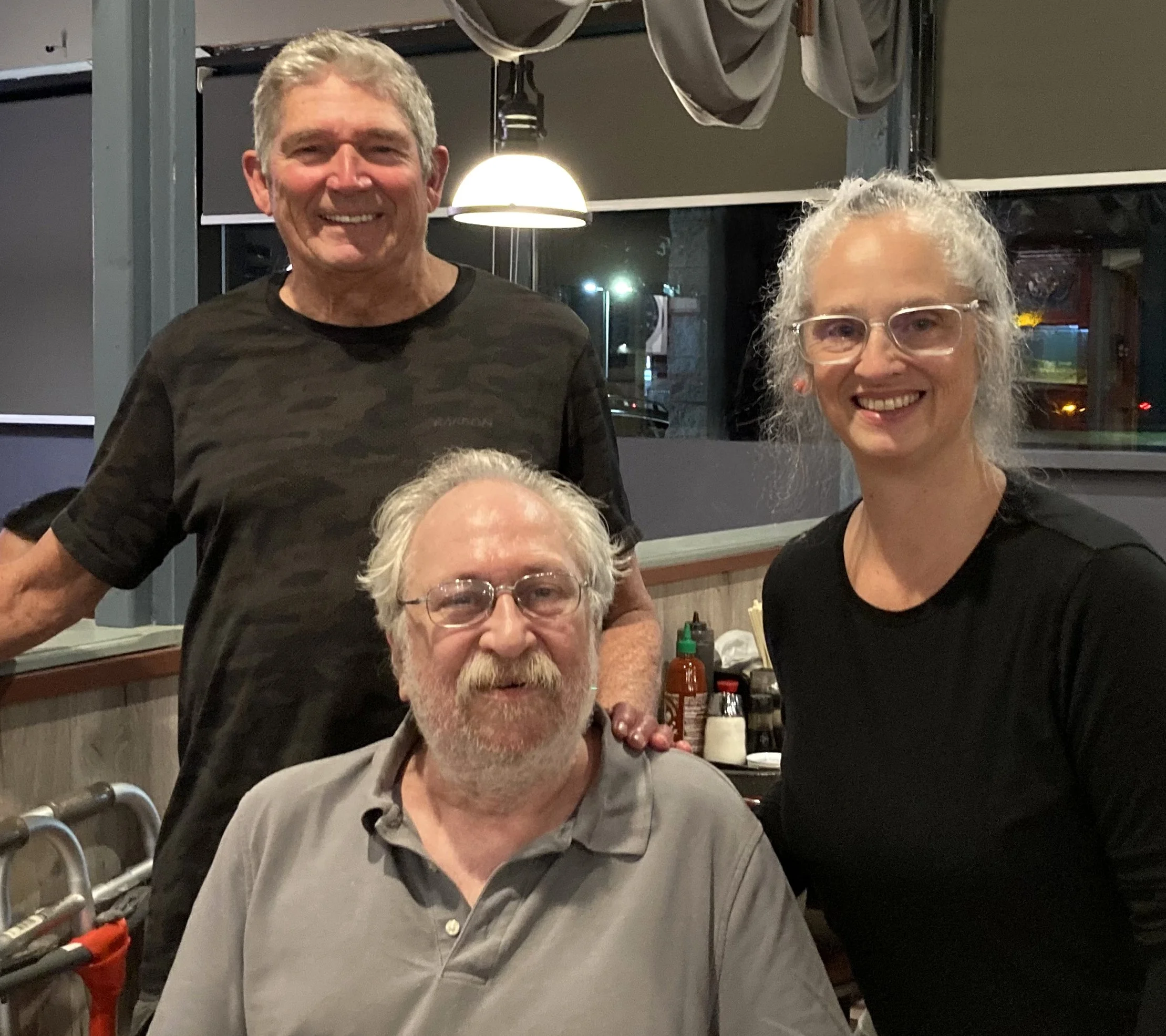
*names have been changed except where we have permission*
Mike Kelley:
I recently visited with Phil, and we were talking about the good old times, including the very first meeting of the Contemplative Fellowship (at Folsom Prison). And he told me that John, who was very instrumental at the time (a very charismatic guy), went over to him and said, “I've got a program we’re just starting, and you're going to it.”
And Phil says if it weren't for that, he never would've showed up. In fact, that’s true for a lot of people in Folsom Prison — they stay away from the chapel. They don't get near the chapel. So, when he was told, “You are going to the chapel,” he said he would have never gone if it weren't for John literally ordering him to go into this meeting.
Phil:
Yeah, short and simple and sweet, I was not going to go in that chapel. It raises too many questions. Plus, I didn't think God wanted anything to do with me.
Mike Kelley:
I shared a little bit of that today [at the practice session for United in Prayer Day]. Isn’t it interesting how people think, “God doesn’t want me; he doesn’t want to have anything to do with me.” We all have our stuff, right?
That's the thing that really was helpful for me as an introvert. I did not want to run a meeting. As we both know, though, as people experienced Centering Prayer, they became more capable of sharing with each other. They started trusting each other... I mean, you don't walk in with a bunch of people you don't know and just start sharing your heart!
No. You just sit there and go, “Hmmm…”. But as people started sharing…
Phil:
When they see other people sharing….
Mike Kelley:
Yeah.
Phil:
Yeah, friends share.
Mike Kelley:
Yeah. So they would start sharing… and eventually, that was the ministry – it was the interaction of people sharing what the healing process was for them (because it's different for every person). And I was able to just sit back and let them take over.
And there were a lot of people, so there was a lot of sharing!
We’d go in a circle, at least when I was facilitating. We always had a sit, and then we would pass a talking stick around, and everybody—uninterruptedly—would share. And if you didn’t have anything to say, that was fine. You could always pass.
There were so many people… and then when we were done going around the circle, we’d open it up for anyone who wanted to add something.
For me – and for all of us – it was all a teaching time. We were teaching each other, and I was just a member… I would just listen, and if I had something to say – like anybody else – I would share. So it really took the pressure off of me. For years and years and years.
Chandra:
Is that how it was from the beginning?
Mike Kelley:
No, at the beginning, like I said, you know… people don’t know each other. There were a few that knew each other, but at the beginning I was teaching – like… I still remember the first time. At the first meeting, nobody had even experienced Centering Prayer. And I had just barely experienced it.
So, I just drew this wheel, and I said, “What we're going to experience with this practice is that you've got all this stuff going on on the outside, and this thing is turning… but as you sit down silently and just keep letting go of the stuff that's going on inside of you, you keep moving down the spokes, and it goes slower. And every once in a while, you might actually get on the hub, where everything stops. All the craziness that’s going on around you – it’s going on out in the yard, it's going on in the tiers, it's going on with the cops, you know, it's like… that just disappears. You just sit in the silence. And you only need a moment of that, to experience a lot of healing.”
So, that was our first meeting. I saw that once people were able to start experiencing the meditation themselves, then they started having things that they could share from experience. But at first, they didn’t have any, so I would come in with some kind of metaphor (like the wheel), that I could talk about a little bit – that would kind of describe it…. Well, maybe it doesn't describe it, but it gives at least some words, you know, to know that there are ways you can try to talk about it, even if you can’t really say what you want to be able to say.
Yeah, for me, it's my “medication” of choice. (You could call it a drug of choice.) But, it's my medication of choice. I would have a hard time… but what's nice is: nobody can take it away from you.
Mike -in serious voice, jokingly impersonating someone:
“Sorry, you can't do this anymore.”
Phil (playing along):
“Oh, yeah? Watch me!”
[laughter]
Mike Kelley:
For a while, we had a Native American that used to bring us out of our sits with a flute.
Chandra:
One of the residents?
Mike Kelley:
Yeah, he was a resident, and he had a flute. He was a Native American. He had a flute that he played, and when our 20 minutes was up, he would just start playing it. So, instead of me ringing a bell and you jumping out of your seat—and other people did that to me, too—you know, when you're in a really deep sit, it doesn't take much to be really startled. Even just the littlest sound can be startling when you're really, really, in a silent place..
But the flute was beautiful. He would just play this music. We would just sit there and enjoy.
Chandra:
So when people talk about it getting up to 400 people who were doing Centering Prayer at Folsom, is that an exaggeration, or is that true?
Phil:
We had a list with 400 names on it, but we rotated, you know? You got to go every four weeks.
Chandra:
And was that because there were certificates being offered or something like that?
Phil:
We never did a chrono.
[In prison, a “chrono” (short for chronological record) is an official written note or report that documents something about a person’s behavior, actions, or status. It’s used to create a paper trail—anything from positive participation to rule violations, medical notes, or program involvement can be recorded as a chrono. Chronos can also be used in parole hearings to help show suitability for parole.]
Mike Kelley:
Nobody got any chrono credit for Centering Prayer at Folsom… Some prisons do that. We deliberately made the choice: if you're going to show up to this it’s because you want to be here. If you want to be here, you just want to be here. … [otherwise] you get people there for the wrong reasons, and they’re there disrupting things, you know. Instead of being there for the silence, they’re talking to the guy next to them during the sit, just killing time. So, that was an absolute “no no.”
Phil:
The guys ourselves said that: we did not want chronos.
[conversation about reasons why some groups try out various forms of giving credit, but most seem to end up abandoning them]
Mike Kelley:
Interestingly enough, we did issue certificates that were suitable for framing for the people who graduated from the Peer Counseling group.
Chandra:
So that group met separately?
Mike Kelley:
Before the meeting. And then when Fr. Keating came, we had him sit up there with the Peer Counselors, up in the upper room, so they had some one-on-one time with him.
Phil:
I was excited about that.
Chandra:
Yeah, that must have been very cool.
Mike Kelley:
There was a time where it was magical. For years, it was magical. We would go in, and there was time for socializing. There was time for Tai Chi, if you do Tai Chi. There was a little rosary group, they would be sitting down with a rosary. Hound Dog was doing a kind of chiropractic adjustments, and there was a Buddhist group.
So we all did whatever we wanted. And if you didn't want to do anything, you could just sit and socialize, one on one.
And then we would start the sit. And then we would all come together, often 50 or more. Sometimes there was a teaching, and then we would do the meditation, and we would pass the talking stick, and people would just share their personal experiences – it's different for everybody, that's the beauty. So, everybody could hear what everybody else's experiences were.
It was really a magical time.
[reminiscing about various people and events]
One of the really special occasions for me was when Father Keating got people together that were in leadership roles outside of prison – and he wanted me there. He said, “We need Mike Kelley there to represent the incarcerated!”
Because of him, I got a scholarship to go and be a part of it.
Chandra:
Where was that?
Mike Kelley:
It was at Burlingame. He just sat up at the front, with about 12 of us, and we had him to ourselves for three days…. Just being there with grandpa, you know. [laughter] And he would ask us questions (because he was struggling with ways to try and come up with diagrams): “But I can't quite figure this out… What do you think?” So he was interacting with us. I liked that a lot.
Unfortunately, I arrived late, and Father Keating’s in the middle of a talk, and he just stops. Drops everything he’s doing, walks over, and gives me a big hug. [laughs] I think of that as real love. … Yeah, he's like the grandpa that none of us have ever had.
And that's kind of what I wanted to share today [in a preparation session for UiP Day], the experience with the love and the affection of Father Keating, and what Centering Prayer had done for him. … But, the same thing happened with men that were experiencing Centering Prayer. They had a lot of what Father Keating had to offer – to each other in the group.
I mean, there’s little things that I remember sometimes, that are really worth… [long pause] just worth a lot.
One of the ones I enjoy is when the Peer Counselors were meeting with Father Keating, and Hound Dog – Oh, I think you [Phil] thanked Father Keating for what he was doing, and Father Keating said something like, “No, no, no! I need to thank you for what you've done with Centering Prayer” – just so we can see what you've done with it.
And then John does his famous little talk…. And then, I mean, you know what he said...
Anyway, he [Hound Dog] starts going, “You didn't have to come here. You're famous. You're famous like Billy Graham, you know, and you come to us. I’m happy as a hound dog that you come over here”, and he just kind of thanked him in his own way – the Hound Dog way.
Chandra:
Yeah, that beautiful heartfelt Hound Dog way.
Mike Kelley:
Hound Dog was there when Folsom was a really brutal place, you know?
I can remember one of the guys say, “Remember that time you knocked that guy’s eyeball out?” It was just hanging there, after Hound Dog finished with him. And then, on this other occasion, some guy was threatening him with a knife, and Hound Dog was annoyed. He said, “You better get ready, because if you go after me with that knife, I'm gonna kill you.”
That was not uncommon for Folsom in the earlier years – they talked about it being a war zone.
Centering Prayer changed a lot of lives.
Phil:
Yeah, that was before we changed.
Chandra:
But you were there for that too?
Phil:
Yep, I was. I spent most of that time in the hole. I was what they called a torpedo, back at the beginning.
Chandra:
What they called a what?
Phil:
A torpedo. … “There's your target, hang him out.”
Then Centering Prayer came along. It took a long time for people to accept the changes in me, you know? There’s a lot of people who didn't want to talk to me. (I didn't talk much those days anyway.)
Chandra:
So [your friend John] got you there?
Mike Kelley:
John didn't give him a choice.
I remember, too, one time, you telling the whole group … you said, “When a lifer tells me to jump, I jump.” And that was one of those moments. John was a lifer.
Phil:
Yep. They were King.
Mike Kelley:
Many lives were changed in Folsom Prison because of Centering Prayer. John was the one that was holding the book when Fr. Keating was there, when it was being videotaped, saying, “Well, we came across this book [Open Mind, Open Heart]” – which I was kind of passing around when I was trying to connect. And he ended up with it, and he read it, and he came to me and said, “Well, this is better than anything we have for a meditation group.”
He was holding the book up, and it had a format for a meeting. So we started having meetings, following the guidelines from the book.
There really was a magical time.
Phil:
Yeah, it was. We got away with stuff that you would not believe we could get away with.
Mike Kelley:
Yeah, I know the guards were really nervous about all the mixed groups, you know, different gang members, because it's like – they have enough trouble with just the Mexicans or just the Hispanics. Because there are two Hispanic groups, two… probably at least two…
Phil:
Norteños and Southerners. Yeah, the BGF, Bloods and Crypts.
Mike Kelley:
There could be a lot of problems with all those divisions, but when we're all coming in together as a mixture – they’re gonna be like, “Oh, man! What if they band together?” Of course, they're thinking, you know, about gangs and the typical stuff, and here? It was like this [change in tone of voice, slow, steady, gentle…]: “Everything that’s about prison gets left out on the steps. When we're in here, we’re not in prison.”
And then there's Barnes, who made the statement, “Not only that, this is a monastery.” [laughing] He told guests that came in, “This is a monastery.”
Phil:
This is our monastery.
Mike Kelley:
And then Johnson…He says, “And I'm a monk.” He says, “This old monk learned some things today.” I remember him telling me that once. We heard the Bernie story – we played a tape – the cook, of the Bernie story, where Father Keating told it? So, one day we took that tape, and we just played it, you know, no videos, no nothing. We just played the whole tape. And I was standing upstairs, by the room, the upper room, and he was standing there next to me (the quality of the sound was really excellent). That was when he told me: “I learned something today. This old monk learned something today.” Whatever he meant – I don't know exactly what he meant by it, but… referring to himself as a monk.
Somebody would stick his head in [to the chapel]. John would say, “Come on in! You are now a contemplative.”
[laughter]
Which is very welcoming… I mean, the person wouldn't know what that meant, but it was a very welcoming thing to say.
Chandra:
You’re one of us.
Mike Kelley:
Yeah. You're one of us. And then eventually, if you stayed, you would find out–years later, probably–what that really means. That's a real process, to really understand what being a contemplative means. Because, you always feel like “I must be doing it wrong. …
I got to be doing something wrong.” But, you can be doing it perfectly!
Phil:
You feel you're doing it wrong.
Mike Kelley:
But you feel like you’re doing it wrong. I feel like I’ve finally come around that now.
Chandra:
There's no way to do it wrong. The only way to do it wrong is to get up and stop doing it.
Phil:
To stop doing it.
Mike Kelley:
Especially if you have good guidance, you know. And, with Centering Prayer, anyway, that really just means returning ever-so-gently, over and over again, to your sacred word…. Remembering that you’re doing it “right,” even if you don’t feel like it…. But then, if you can sit there for that period of time and just keep at it long enough, you could move into that space where there’s something good happening – somehow here I am, in union with the Divine Presence.